
The Gibson County Arrest Log
The Milan Mirror-Exchange and Gibson County News publish the "Right to Know" series, the main multi-day source for Gibson County arrests. Editions from June 10, July 22, August 26, and September 9, 2025 show sheriff reports running on a steady cycle. Some editions add a Humboldt Police Report. The publisher draws from court records and prints the material as received. Treat it as delayed local news. It is not the sheriff's booking database. Coverage runs roughly weekly but stays loose. One July edition covered July 5 through July 20. Holiday production has combined even longer periods. An article date, an arrest date, and the date a court record opened can all differ, and no fixed publication hour exists.
The September edition shows how separate agency blocks appear in the report. View the September 9 Right to Know source.
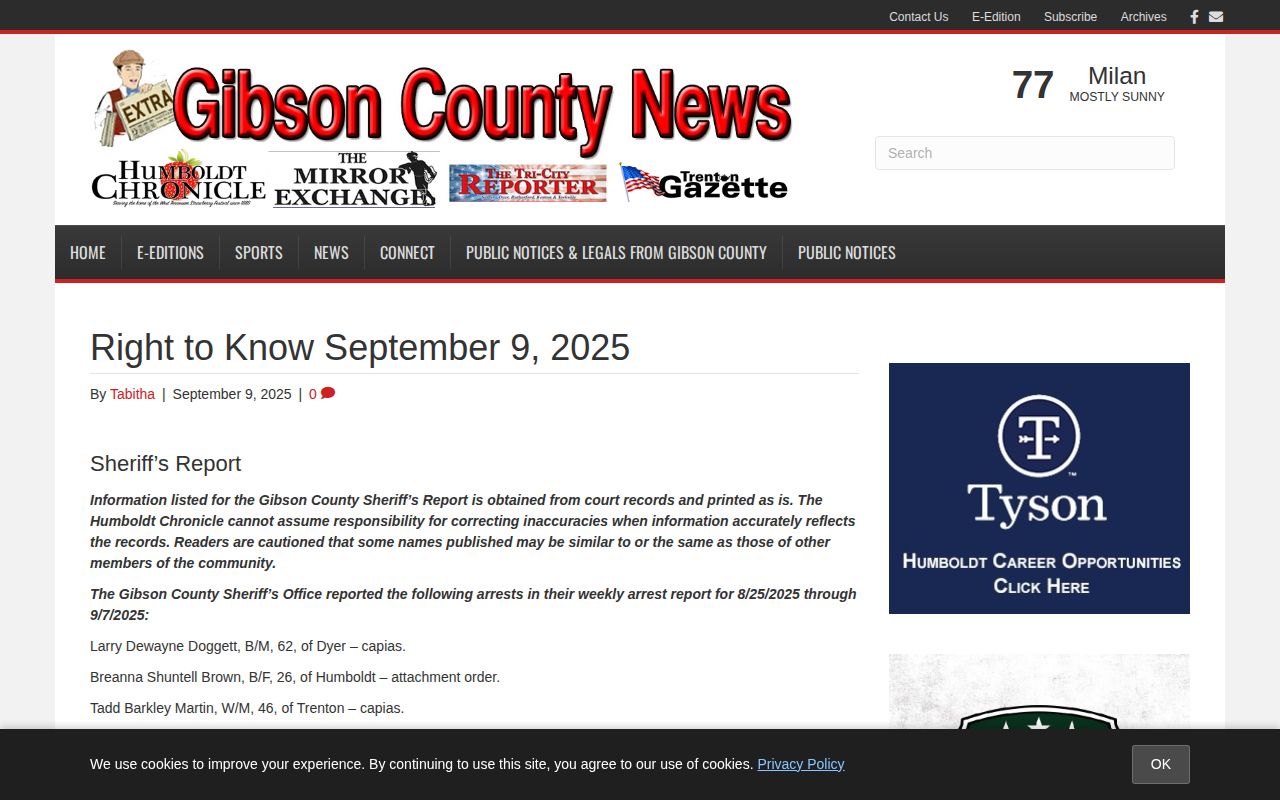
The capture documents the local reporting format without turning it into a booking-photo gallery.
How to Read the Gibson County Blotter
Start at the newspaper's website and search the archive for "Right to Know." Match the article's stated coverage dates to your event. Someone arrested near a weekend or holiday may surface in a later or combined edition. Never assume the newest article covers the previous calendar day.
- Open the article and record its publication date and stated report period.
- Identify whether the entry appears under the Gibson County Sheriff or Humboldt Police heading.
- Compare the name, age, city, arrest date, and agency details to avoid a mistaken match.
- Contact the sheriff or police department for the official arrest or booking record.
- Use the relevant court clerk for the later charge and disposition.
The newspaper warns that people with similar names may appear in its pages. A name alone proves little. For an arrest from the last few hours, skip the weekly archive and use the Gibson County Arrested Today workflow instead. No official daily online feed exists for Gibson County.
What an Arrest-Log Entry Shows
The sheriff blocks carry a compact set of fields. Humboldt's police block adds detail that the county portion often lacks. The table describes newspaper fields only, not every field the jail or court keeps on file.
| Field | Observed use |
|---|---|
| Name | Person named in the reported arrest |
| Race/sex and age | Descriptors printed by the source |
| City | Reported place associated with the person |
| Arrest date | Date of the reported event, not necessarily intake time |
| Charge | Charge as reported from the source record |
| Location | Seen in sampled Humboldt police blocks |
| Arresting officer | Seen in sampled Humboldt police blocks |
A booking number, bond, intake time, release date, custody status, and booking photograph do not appear consistently in the print report. Guesswork cannot fill those gaps. Ask the jail for booking and release data. Request the city police report for the incident and the docket for the final outcome.
Weekend and Holiday Arrests
Weekend and holiday arrests ignore the newspaper's production schedule. The jail books people around the clock while the report lands days later. A combined edition does not mean jail work paused. It only groups a wider window. The publisher does not post exact delivery or posting times. When timing matters, call the Gibson County Correctional Complex. The number is (731) 855-1121. Ask whether the person is booked, held, released, or transferred. City departments handle their own reports, so call the arresting agency for those. For booking photos, records requests, warrants, and custody systems, use the county-wide arrest record path. Note: Write down the time of each call. A custody answer can change after bond, release, or transfer.
Archives and Retention
Indexed Right to Know pages reach back several years, with examples from 2019 and 2024. Still, the newspaper site is not a complete official archive. Pages move or vanish. Some arrests never make print. Search by article title, date range, and agency, then save the exact URL and publication date. For older records, ask the sheriff or the court clerk first. The CTAS model schedule places arrest records and identification files under long retention frameworks. Inmate census and booking logs sit at five years. Jail registers are permanent. Formats vary county to county, CTAS warns. A daily log can roll off. Yet a permanent register or case file survives. The Tennessee State Library and Archives holds Gibson County court minutes, newspapers, and microfilm. Those routes fit historical research, not a modern mugshot search. Any request should name Gibson County, the agency, the person, the date range, the record series, and a case or booking number if known.
Gibson Arrest Agency Blocks
The report splits its arrest blocks between the Gibson County Sheriff's Department and Humboldt Police. That split matters. Each agency keeps its own paperwork. The sheriff's office typically holds the county booking record. Humboldt Police, meanwhile, hold the incident report for arrests inside the city. A single arrest in Gibson County can generate both. The fields may not match, since each captures a different stage of the event.
Milan runs on a different system. Its city code calls for a municipal daily police record, though nothing is posted online. Trenton's police page offers contact details only, with no arrest feed of any kind. A missing newspaper block says nothing. It does not tell you whether the city made arrests.
For county custody questions, the sheriff's contact line comes first. The newspaper stays secondary. Commercial sites that copy Gibson County names or booking photos can go stale fast. None of them serves as a warrant, custody, or disposition source.
Verify Gibson Arrest Outcomes
Criminal cases in Gibson County start close to home. General Sessions Court handles the first hearings after an arrest, along with warrants and bond. A felony charge that keeps moving may later shift to Circuit Court. Humboldt and Trenton each keep a city court clerk contact. The state AOC listing includes both. Match the booking details to the right docket before you call.
Charges rarely stay frozen. A case may be reduced or dismissed. The grand jury may drop it, or a plea may resolve it. Some go to trial outright. Expungement, when a case qualifies, begins in the court where the case started. It never happens on its own.
For routing, rely on the Tennessee clerk directory. It covers both the Gibson County clerks and the city clerks.
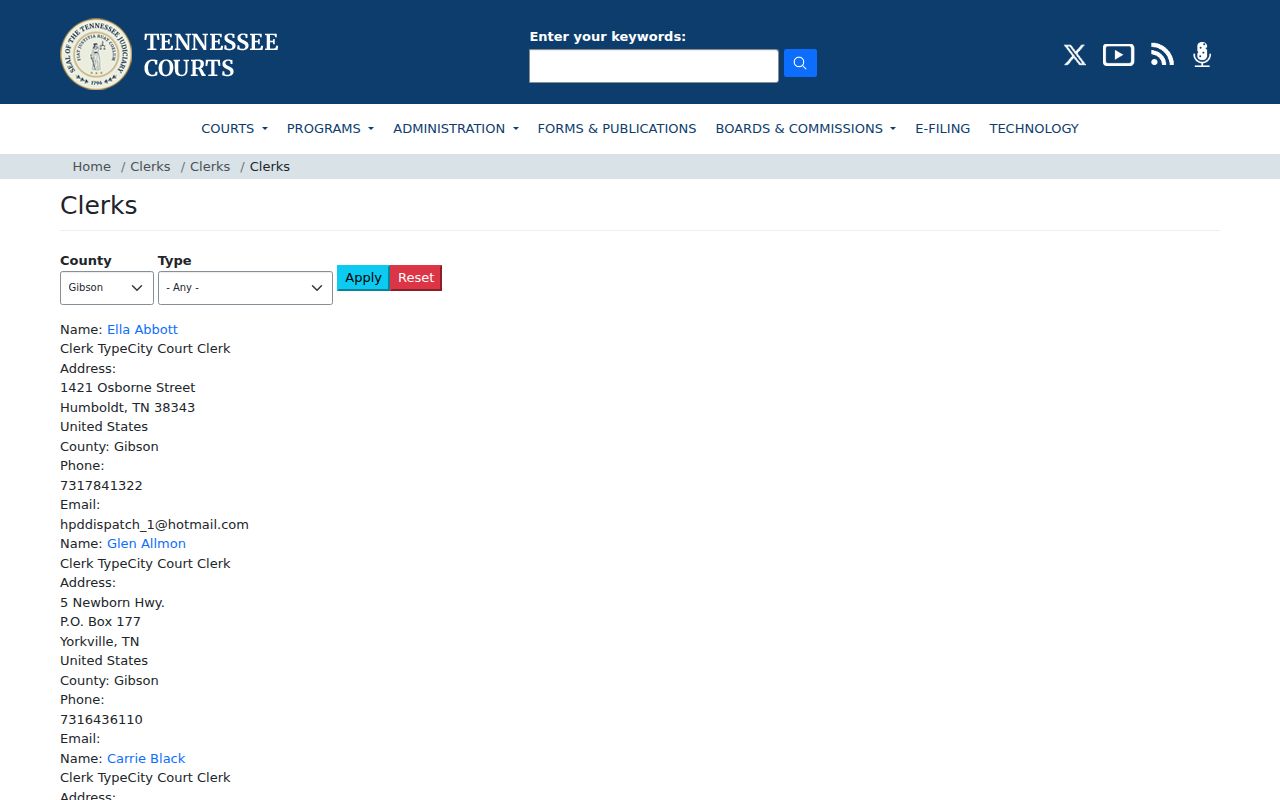
Note: the directory routes case requests only, with no live booking roster attached.
Public Record Search
Sponsored Results